Replacing a 550 kV SF6 breaker can mean major cost and long lead times. Reconditioning is the alternative — if the work ends in certification.
When a high-voltage SF6 circuit breaker comes out of service, the question isn’t just whether it can be repaired. It’s whether it can be returned to service with documented proof that it will perform when a fault arrives.
That question matters more than usual for large dead-tank breakers at the top of the voltage class. New units carry significant cost and long lead times, and on older platforms, key components may no longer be manufactured at all. Reconditioning is a cost-effective and environmentally sound alternative to replacement but only when the work ends in certification. Here’s what that process actually involves.
It Starts With the Gas
Before a single component is unbolted, the SF6 itself is worth interrogating. The condition of the gas is a direct reflection of the condition of the equipment, and a quality analysis tells you how large the job might be before anyone lifts a wrench.
Three parameters carry most of the diagnostic weight.
- Purity speaks to dielectric strength. Contamination from air entering through leaks or improper handling dilutes the SF6 and degrades its ability to insulate and quench an arc.
- Moisture is arguably the most dangerous contaminant. It undermines dielectric properties and is a leading indicator of future corrosive damage.
- Sulfur dioxide is the fingerprint of the breaker’s operational history. Its presence means that breaker has seen significant arcing, pointing toward accelerated wear on the arcing contacts and possible thermal damage inside the interrupter.
Those three indicators, read against the applicable standards, turn a routine rebuild into an informed one. IEC 60376 sets the purity target for new, technical-grade SF6. IEC 60480 governs the criteria for re-using gas recovered from equipment already in service — the relevant benchmark here. ANSI/NETA ATS then defines the acceptance criteria the results are measured against.
A poor result isn’t bad news so much as an early warning of what’s waiting inside.
Down to the Components
The reconditioning process then works through the breaker system by system. Steel frames and control cabinets are blasted or sanded to bare metal, primed, and top-coated to the original manufacturer’s color specification. High-voltage bushings are uncrated and examined for cracking, chipping, and flashover tracking, then cleaned and re-crated for protection until assembly.
The operating mechanism gets the closest attention, because it supplies the motive force and precise timing the breaker depends on to interrupt fault current.
ABB’s AHMA-8 hydraulic mechanism is a useful case in point — both for what an overhaul involves and for what happens when a critical component is no longer made. On the AHMA-8, an overhaul means draining and replacing fluid; cleaning the reservoir; changing filters; inspecting pump motor, drive gear, pilot valves, seals, gaskets; lubricating linkages; and vacuum-evacuating, refilling, and verifying pressure setpoints.
This is also where obsolescence becomes a practical engineering problem. The AHMA-8 has been discontinued for years. If one fails testing, the only path forward is retrofitting to the current HMB-8, and ABB recommends replacing all three mechanisms in a group when one goes.
Bushing current transformers are tested independently while the breaker is apart; insulation resistance, winding resistance, ratio, polarity, and excitation and compared against ANSI/NETA ATS criteria and against each other to expose outliers.
Proof, Not Assumption
Reassembly is where maintenance becomes certification.
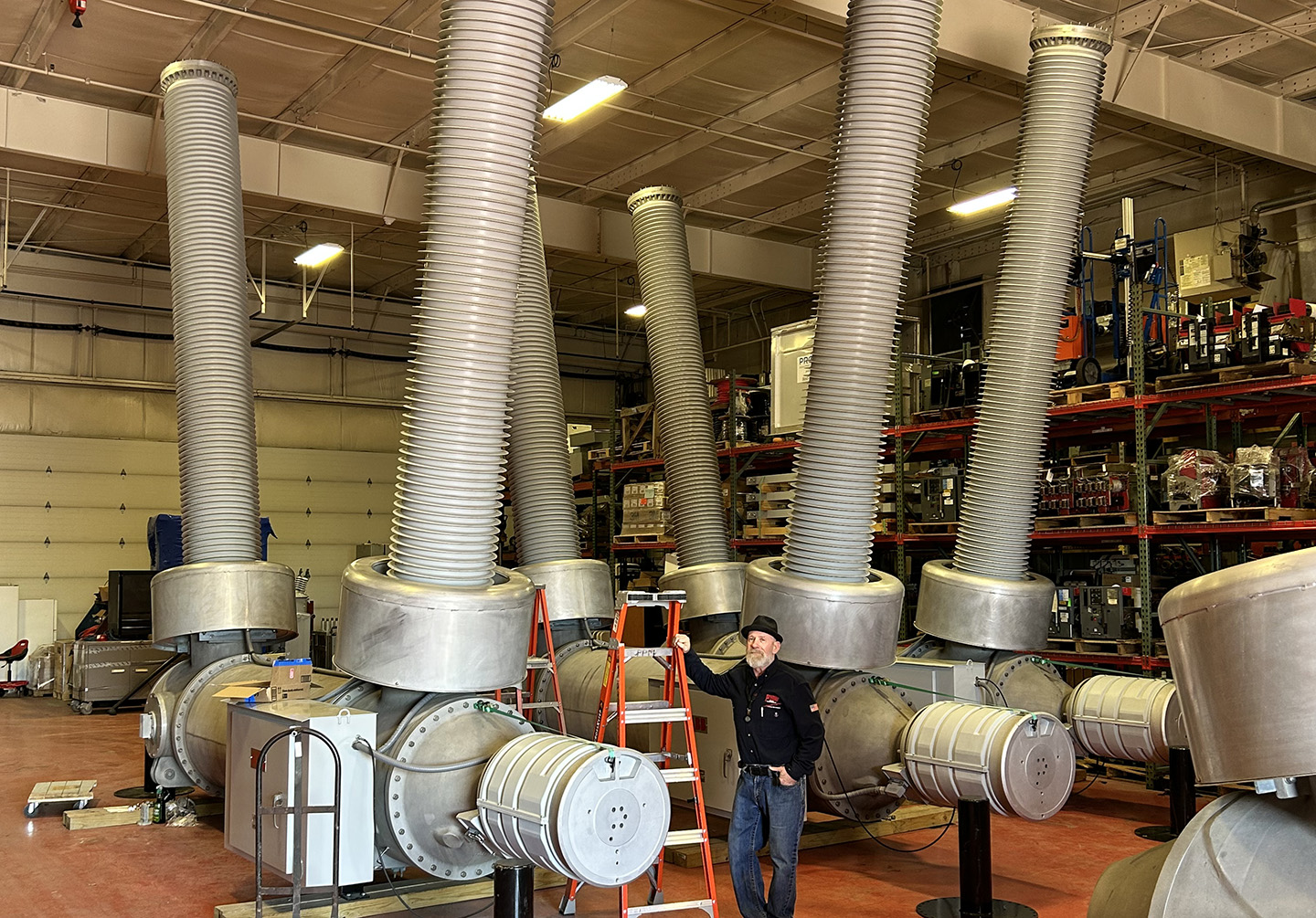
Each breaker is assembled on an engineered concrete test foundation built to withstand the static and dynamic forces of operation. Tanks are opened for internal inspection, old desiccant is replaced, and new end-plate gaskets are installed and torqued to specification.
Gas handling follows. Each pole tank is evacuated to a deep vacuum below 1.0 millibar and held for at least four hours to boil residual moisture off internal surfaces. Then they’re filled to the manufacturer’s specified density adjusted for ambient temperature. Every gasket, fitting, and valve is checked with a detector capable of identifying leak rates below 0.5% per year. All of it runs through zero-emission Dilo equipment, which reclaims over 99% of the gas rather than venting a potent greenhouse gas to atmosphere.
Then the breaker has to prove the work held. A full battery of ANSI/NETA acceptance testing puts the reassembled unit through insulation resistance testing at 15,000 VDC, contact resistance measured by 100 A low-resistance ohmmeter, power factor testing across bushings and interrupters, and a reconditioning process that verifies open and close times, contact stroke and velocity, and synchronicity between poles within milliseconds. Each test produces a documented value measured against manufacturer tolerances and ANSI/NETA ATS acceptance criteria, objective evidence rather than assurance.
What the owner receives is a certified asset and a documented performance baseline to measure against for the rest of its service life. That’s the real argument for reconditioning over replacement: not simply that it costs less, but that done properly, it ends with proof that the breaker will work when called upon.
Considering reconditioning your SF6 fleet? Talk to a Premier Power Maintenance expert about gas analysis, mechanism overhaul, and ANSI/NETA ATS acceptance testing.